
A polished advertisement can create interest. Only verifiable facts should create trust.
By Andrew McLoughlin
Vice President of Admissions & Operations
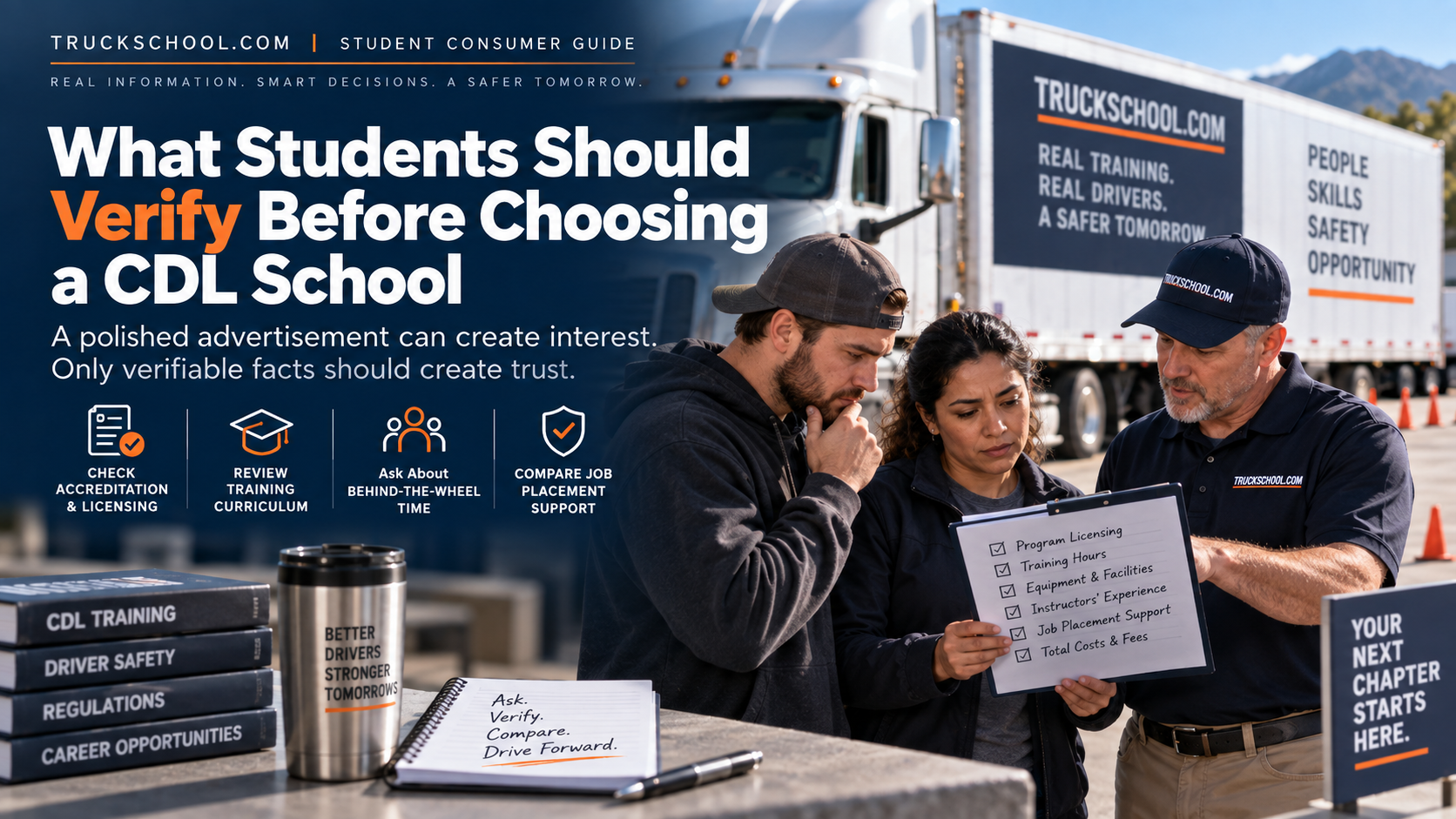
Choosing a CDL school should involve more than comparing the first price, the shortest schedule, or the loudest promise.
Students are making a serious financial and career decision. Many will leave work, arrange childcare, travel, pay for housing, or commit several weeks of their lives to training. They deserve clear information before signing an enrollment agreement or paying a deposit.
Here are the questions I believe every prospective student should ask.
Is the provider properly listed and licensed?
Drivers subject to Entry-Level Driver Training requirements must use a provider listed on the FMCSA Training Provider Registry for the required training. Students should search the provider and the specific training location rather than relying on a logo placed on a website.
A registry listing is important, but it is not the only question. Students should also verify applicable state school licensing or authorization. The federal registry and state licensing serve different purposes.
What is the actual program?
Ask for the exact program title, scheduled clock hours, length, daily schedule, attendance requirements, graduation requirements, and major training components. Understand how classroom instruction, online theory, simulation, inspections, range exercises, and supervised public-road driving fit together.
Do not assume that two programs using the words “CDL training” provide the same amount or type of instruction.
How much access will students have to equipment?
Ask how many students are scheduled around each vehicle, how practical sessions are organized, and what a normal training day looks like. Observing other students can be useful, but observation should not be presented as individual practice.
Students should also ask whether the vehicles are representative of the class of CDL being pursued and whether the school has a plan for equipment downtime.
Who are the instructors?
FMCSA publishes qualification requirements for Entry-Level Driver Training instructors, and states may impose additional requirements. A prospective student should be able to ask about instructor qualifications, experience, and how progress is evaluated without receiving a vague answer.
Do not ask only, “Can I start?” Ask, “What exactly will happen between enrollment and completion?”
What does tuition include?
Ask for the full cost in writing. That includes tuition, registration fees, permits, testing, retesting, physical examinations, drug testing, transportation, lodging, equipment, and any other required expense, as applicable.
If financing is offered, review the total obligation, payment schedule, cancellation terms, and what happens if the student withdraws, does not complete, or does not obtain employment. A weekly payment is not the total price.
How does testing work?
Students should understand whether testing is included, scheduled separately, conducted on site, or handled by an outside party. Completing school is not the same as automatically receiving a CDL. The applicant must still satisfy applicable licensing, knowledge-testing, skills-testing, medical, and state requirements.
What does employment assistance actually mean?
Ask what the school does: resume preparation, employer introductions, application support, interview practice, job leads, or other services. Then ask what the school does not guarantee.
No responsible school should guarantee that every graduate will be hired, earn a certain wage, receive a local route, or work for a particular employer.
Read before signing
The enrollment agreement, school catalog, refund policy, financing contract, and program disclosures matter more than a verbal promise. Students should receive time to read them and ask questions.
A trustworthy school will not be offended by verification. It will expect it.
The right school is not necessarily the least expensive, the longest, or the closest. It is the school that fits the student’s goals and can document what it offers without hiding the conditions.
JOIN THE CONVERSATION
What information should every CDL school be required to publish before accepting a student’s deposit?
#CareerTraining #WorkforceDevelopment #SkilledTrades
Sources
FMCSA Training Provider Registry: Selecting a Provider
