
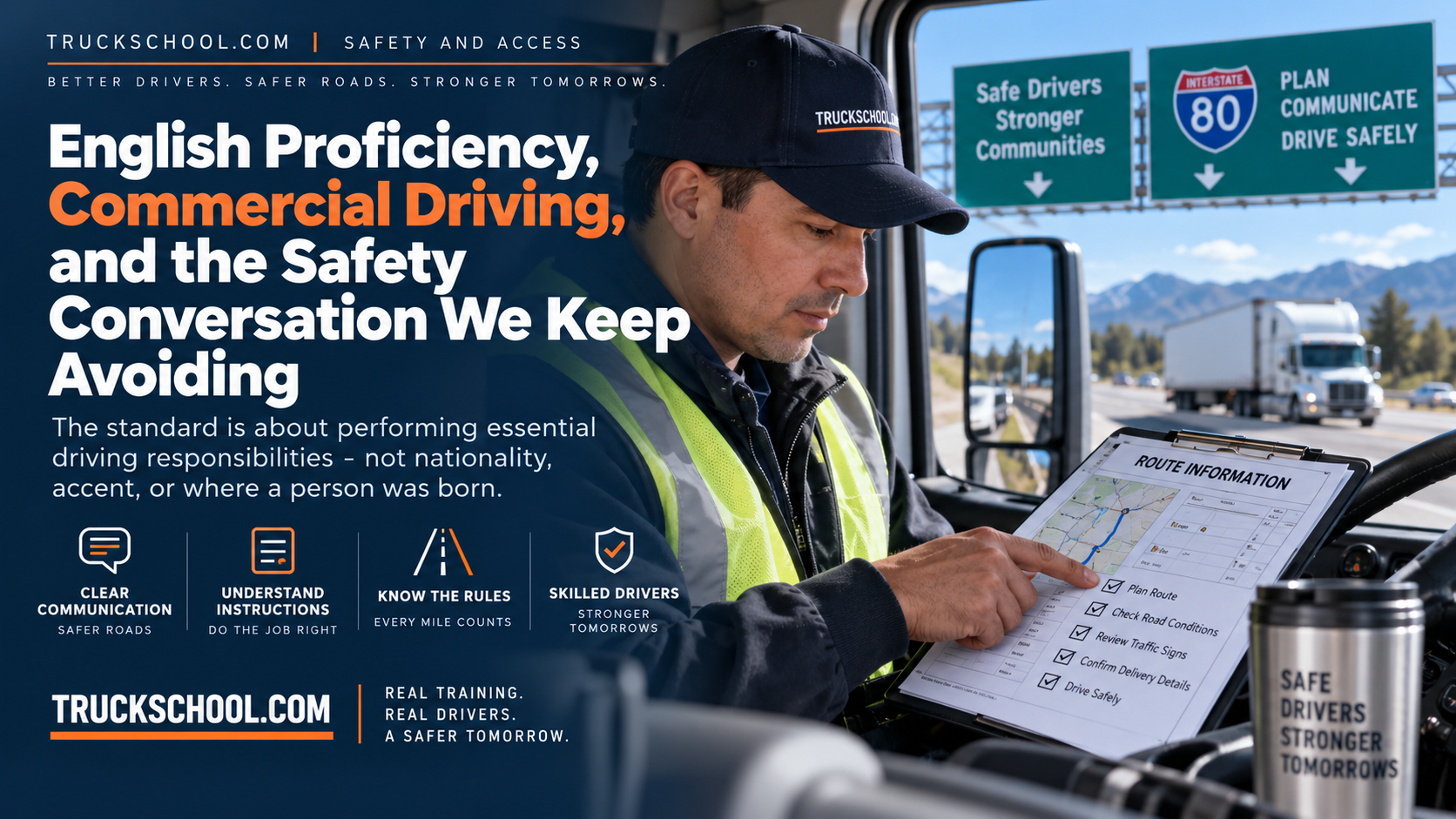
The standard is about performing essential driving responsibilities – not nationality, accent, or where a person was born.
By Andrew McLoughlin
Vice President of Admissions & Operations
Commercial-driver English proficiency is a difficult subject because people often enter the conversation ready to defend a political position instead of discussing the actual job.
The federal qualification rule requires covered commercial motor vehicle drivers to have sufficient English ability to communicate with the public, understand highway traffic signs and signals, respond to official inquiries, and make entries on reports and records.
FMCSA’s current roadside enforcement guidance addresses how compliance with that rule is evaluated. The requirement is real, and students considering commercial driving deserve to hear about it before investing in training.
This is not a test of identity
A person’s nationality, first language, or accent does not determine whether that person can become a safe professional driver. Thousands of successful drivers learned English as a second language. An accent is not a safety violation.
The relevant question is whether the individual can perform the English-language tasks required by the regulation and the job.
Turning that question into an argument about immigrants or ethnicity is unfair and unproductive. Ignoring the requirement is also unfair, especially to a student who may complete training and then encounter a licensing, enforcement, or employment barrier that was never explained.
Why communication matters on the road
Commercial drivers must understand signs, instructions, route restrictions, emergency directions, shipping information, and communications from law enforcement and inspection personnel. They complete records, report defects, communicate with dispatchers and customers, and explain unexpected events.
Technology can translate many things. It cannot be assumed to work in every roadside, emergency, loading-dock, or enforcement situation. The driver remains responsible for operating safely and responding appropriately.
The respectful approach is to help qualified non-native English speakers meet the standard – not pretend the standard does not exist.
Schools should explain the requirement early
A prospective student should know that completing a training program does not guarantee a CDL or employment and that English proficiency may affect the person’s ability to satisfy applicable requirements and perform the job.
That conversation should happen before enrollment, not after tuition has been paid. Schools should use plain language, apply the same policy consistently, document what they communicate, and avoid making assumptions based on appearance or accent.
Preparation is better than exclusion
If a student needs help, the answer should be a realistic preparation path. That may include English-language instruction focused on traffic signs, vehicle components, inspections, directions, official questions, records, and common workplace communication.
The school should not claim to offer language services it does not provide, and it should not lower safety or completion standards. It can refer the student to appropriate resources and explain what must be demonstrated.
Students also need an honest self-assessment. Memorizing a small set of answers is not the same as being able to respond when the question changes or an emergency occurs.
Consistency protects everyone
A clear, written approach protects students from surprise and protects schools from arbitrary decisions. It also helps employers understand what the training provider discussed and what the graduate has demonstrated.
The industry should welcome people from every background who can meet the requirements and perform the work safely. We should also be honest that commercial driving carries communication responsibilities that cannot be marketed away.
This conversation does not need more anger. It needs accurate information, consistent standards, and meaningful support for people willing to prepare.
Sources
FMCSA: 49 CFR 391.11 General Qualifications of Drivers
FMCSA: English Language Proficiency Roadside Enforcement Policy
FMCSA: Assessing English Language Proficiency During Driver Qualification
