Online theory can teach knowledge. It cannot replace inspections, backing, vehicle control, or supervised road experience.
By Andrew McLoughlin
Vice President of Admissions & Operations
Commercial driving is one of the clearest examples of where technology can improve education without replacing the real work.
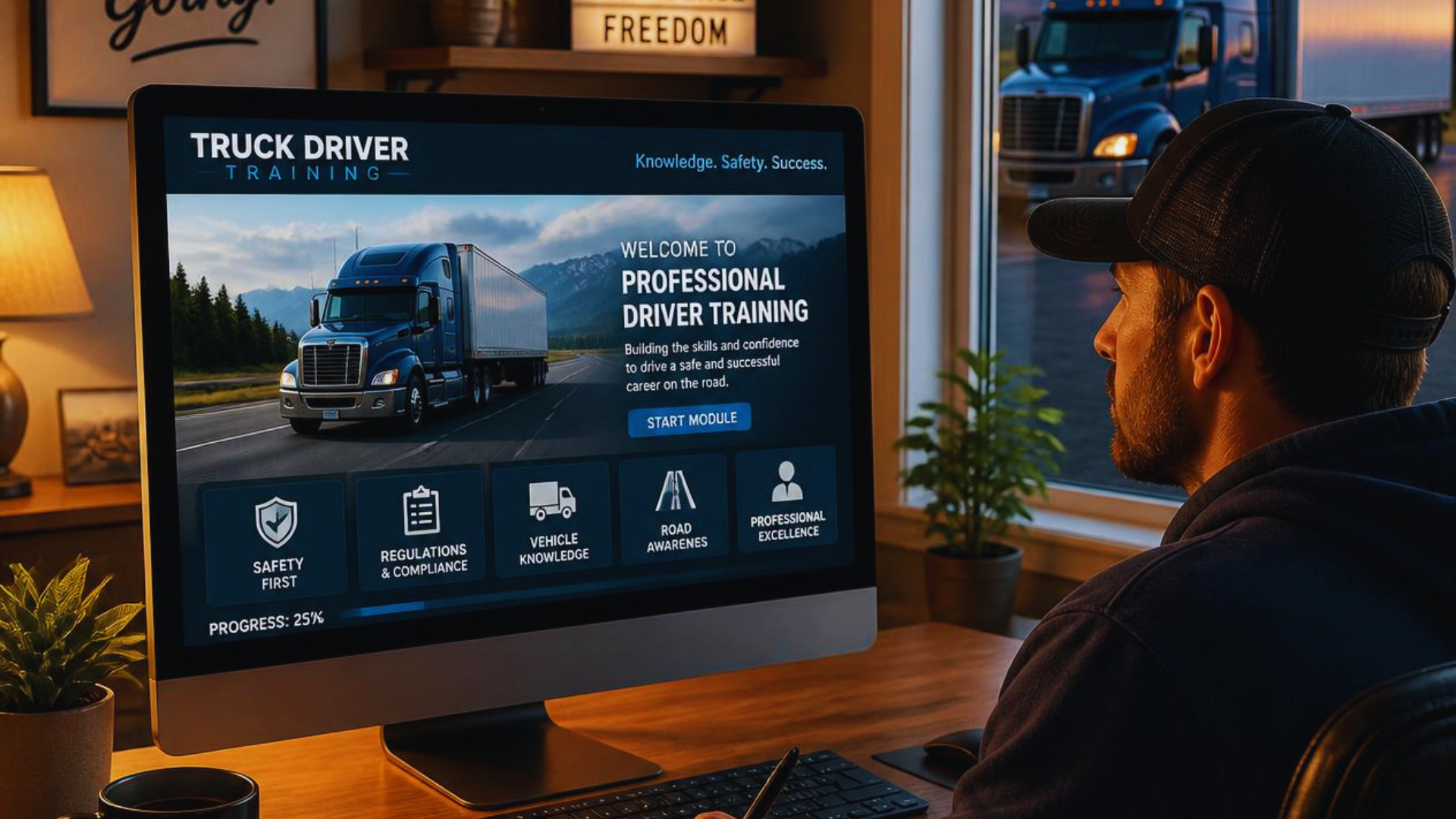
Online instruction has a legitimate place in CDL education. It can explain regulations, vehicle systems, safe-driving concepts, trip planning, hours-of-service requirements, and many other theory subjects. A well-designed online course can let a student review difficult material and demonstrate knowledge before moving to practical instruction.
But a student cannot learn the full responsibility of controlling a commercial vehicle through a screen.
Federal rules recognize the difference
The federal Entry-Level Driver Training framework separates theory instruction from behind-the-wheel training. Theory may be delivered online by a registered provider. Behind-the-wheel training must occur on a range and public road in a representative vehicle, and required proficiency is assessed by a qualified instructor.
FMCSA also states that a driving simulator cannot substitute for mandatory behind-the-wheel training. Simulation may support theory instruction, but it cannot be used to demonstrate proficiency in the required behind-the-wheel curricula.
That distinction is not anti-technology. It is common sense.
A screen cannot reproduce consequence
A video can show the steps of a pre-trip inspection. It cannot make a student identify a real defect on a real vehicle. A lesson can explain off-tracking. It cannot reproduce the judgment required when a long trailer moves through a tight turn. A simulation can create a backing scenario. It cannot reproduce every mirror limitation, surface condition, trailer response, pedestrian, or pressure of the moment.
Commercial vehicles provide physical feedback through steering, braking, vibration, sound, visibility, and movement. Students need to experience that feedback while a qualified person can observe, stop, correct, and require repetition.
Online learning can deliver information. Only supervised practice can begin turning that information into safe behavior.
Hands-on does not automatically mean good
It is also important to tell the whole truth: simply placing a student near a truck does not create meaningful training. Practical instruction needs structure.
Students should receive clear demonstrations, supervised practice, specific feedback, and opportunities to repeat required skills. They should understand what they are doing and why. Waiting in a group while a truck makes a few circles is not the same as developing proficiency.
The quality of the instructor, the training plan, the equipment, the student-to-vehicle arrangement, and the honest use of scheduled time all matter.
Technology should prepare students for the truck
The strongest use of technology is to make practical training more productive. Students who understand terminology, procedures, and safety concepts before approaching the vehicle can use their hands-on time more effectively.
Simulation can help students become familiar with controls and decision-making in a controlled setting. Videos can reinforce inspections and maneuvers. Electronic assessments can identify theory topics that need review. None of those tools need to pretend they are the vehicle.
The public has a stake in the answer
CDL training is not only a private transaction between a school and a student. The graduate will operate beside families, school buses, work crews, emergency responders, and other professional drivers. That public responsibility is why training claims deserve scrutiny.
A school should never promise that completing a program guarantees a CDL or employment. It should provide the instruction it advertises, document completion honestly, and support preparation for applicable knowledge and skills testing.
Online theory can be convenient, effective, and appropriate. Behind-the-wheel skill still has to be developed behind the wheel.
Technology should help us train better. It should never become an excuse to avoid the equipment, the instructor, or the responsibility.
JOIN THE CONVERSATION
Where should online learning and simulation end, and where must hands-on CDL instruction begin?
#CareerTraining #WorkforceDevelopment #SkilledTrades
Sources
FMCSA Training Provider Registry: Training Requirements FAQs
FMCSA: Entry-Level Driver Training Minimum Federal Curricula
